HVAC COIL TREATMENT & AIR DISINFECTION
Dirty Coils Are Costing You More Than They Should
HVAC is the largest energy load in most commercial buildings — and biofilm on cooling coils quietly degrades it every day. UV-C keeps coil surfaces clean continuously, with no chemicals, no shutdowns, and no manual cleaning.
WHAT FOULED COILS ACTUALLY COST
The Compensation Is the Expense
Biological growth on cooling coils is continuous and unavoidable. Coil surfaces stay wet, stay dark, and stay warm — ideal conditions for biofilm. The cost shows up indirectly. Heat transfer drops. Pressure drop rises. Then the system compensates: fans speed up, chilled water temperatures drop, pumps push harder, and in some buildings standby chillers come online. Every one of those adjustments consumes energy the original design never budgeted for.
The conventional fix is manual coil cleaning — labor-intensive, disruptive, periodic, and effective only until fouling resumes. UV-C coil treatment works continuously instead, irradiating the coil surface and drain pan to prevent buildup at the source.
Continuous, Not Periodic
No Chemicals, No Shutdown
Eliminates Manual Coil Cleaning
Restores Design Performance
Lower Fan Energy
Longer Equipment Life
THE MECHANISM
UV-C Doesn’t Save Energy. Clean Coils Do.
This distinction matters, and most UV-C marketing gets it wrong.
Coil irradiation does not reduce energy consumption by itself. What it does is keep coil surfaces free of biological buildup so that heat transfer and pressure drop return to — and stay at — original design conditions. The savings come when those restored conditions allow the compensating adjustments to be reversed: fans slowed, chillers returned to design parameters, VFDs applied where appropriate.
ASHRAE’s UV-C technical committee has documented this in the HVAC Applications Handbook, establishing minimum irradiance levels at the coil surface specifically to control mold and bacteria, reduce or eliminate coil cleaning, and sustain coil performance. Reported energy savings once coil capacity is restored fall in the range of 10 to 25 percent. Capturing the full range depends on your controls being returned to design conditions. We’ll tell you honestly what to expect for your system.
WHAT IT COSTS
Often Less Than the Coil Cleaning You’re Already Paying For
For properly designed systems above 10,000 CFM, UV-C retrofit costs can run as low as $0.15 per CFM — frequently less than a single thorough coil cleaning, which then has to be repeated. That reframes the decision. This isn’t new spend competing for capital budget. For most buildings it substitutes for recurring maintenance you’re already funding, and it stops the efficiency loss between cleanings.

Application Kits for Every AHU Size
UV-FCU-CL Series — engineered kits for standard AHU configurations

Magnetic
1–10 Tons / 400–4K CFM
Solution: 33″ UV-C Lamp
Mount: Magnetic Mounting Kit
Lamp Qty: 1

Single-Strut
10–50 Tons / 4K–20K CFM
Solution: 61″ UV-C Lamps
Mount: Single Strut Kit
Lamp Qty: 2
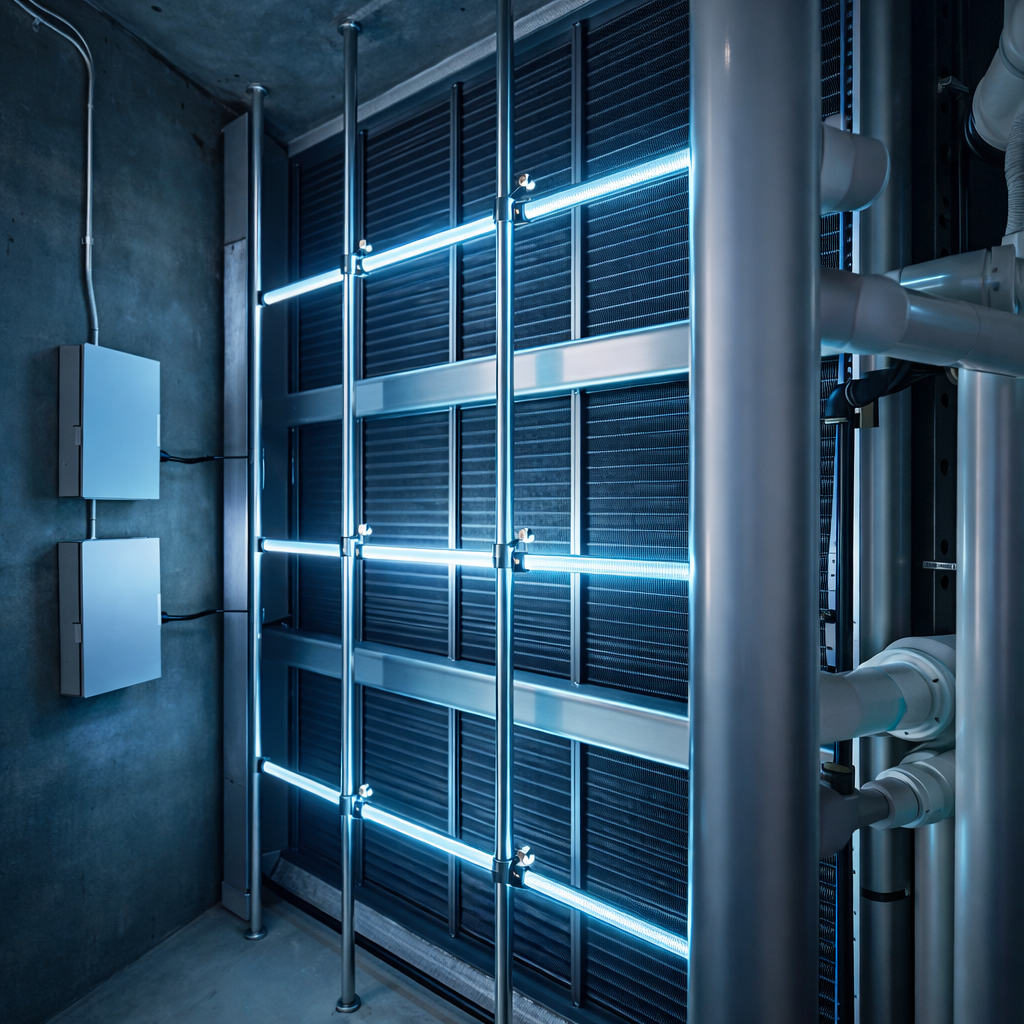
Multi-Strut
50+ Tons / 20K+ CFM
Solution: 61″ UV-C Lamps
Mount: Multiple Strut Kit
Lamp Qty: 3 to 8
SIZING
Coil Sizing Is Straightforward. We’ll Do It for You.
Sizing UV-C for coil treatment is geometry, not guesswork. ASHRAE guidance specifies minimum irradiance at the coil surface — including at the corners, the hardest point to reach — and lamp output is derated for the temperature, air velocity, and plenum reflectance of the actual installation. Send us your coil dimensions and we’ll return lamp count, configuration, and an estimated payback.
We’ll respond within one business day with lamp count, configuration, and estimated payback. No obligation.
IN-DUCT DISINFECTION
A Different Problem: The Air Itself
Coil treatment addresses surface fouling and the energy it costs. In-duct UV-C addresses something else entirely — the microbial load carried in the airstream. Sizing here is genuinely more complex: effective dose depends on airflow rate, duct geometry, residence time in the irradiated zone, and the target organism. This is where our in-house engineering team does the work. You provide the operating conditions, we calculate the dose and validate the configuration before anything ships.
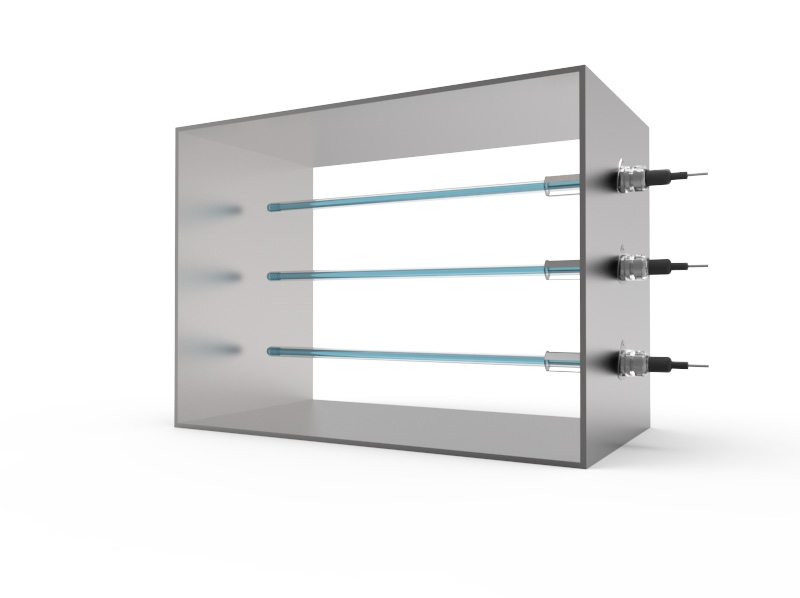
IN-DUCT

UV-DUCT-SQ
A grid of UV-C lamps spanning the full duct cross-section. Stainless steel construction, multiple lamp and wattage configurations. Designed to fit existing duct dimensions with minimal modification.
IN-DUCT
UV-STYLO-X
Compact, pencil-style UV-C lamp for narrow AHU spaces and retrofit installs. No duct cutting required. Simple bracket mount with multiple wattage options to match system requirements.
STANDARDS & COMPLIANCE
Two Standards, Two Different Questions
Coil treatment follows ASHRAE Handbook guidance from the UV-C technical committee, which sets minimum irradiance levels at the coil surface to control biological growth and sustain coil performance. Airstream disinfection is addressed by ASHRAE Standard 241, Control of Infectious Aerosols, which recognizes UV-C as an equivalent air cleaning technology for meeting Equivalent Clean Airflow targets. Light Progress systems are engineered around dose, geometry, and operating conditions — the factors that determine whether a system actually performs in the field rather than on a datasheet.
GETTING IT INSTALLED
We Don’t Hand You a Box
Most UV-C projects stall not on cost but on execution — who installs it, who verifies it, who maintains it. Light Progress North America coordinates installation directly. If you have a service contractor you already trust, we’ll work with them and provide the specifications and support they need. If you don’t, we’ll help you find one. Systems are stocked in Coppell, Texas, so lead times are measured in days.
START HERE
Tell Us About Your System
Send coil dimensions for a sizing estimate, or describe your application and we’ll tell you what’s realistic. Either way, you’ll talk to someone who does this every day.
Service contractor interested in carrying Light Progress? Learn more →